AI-Generated Profile Photos: How to Spot a Fake Dating Profile
aimagedetector.ai Team · July 2, 2026 · Updated August 23, 2026 · 5 min read
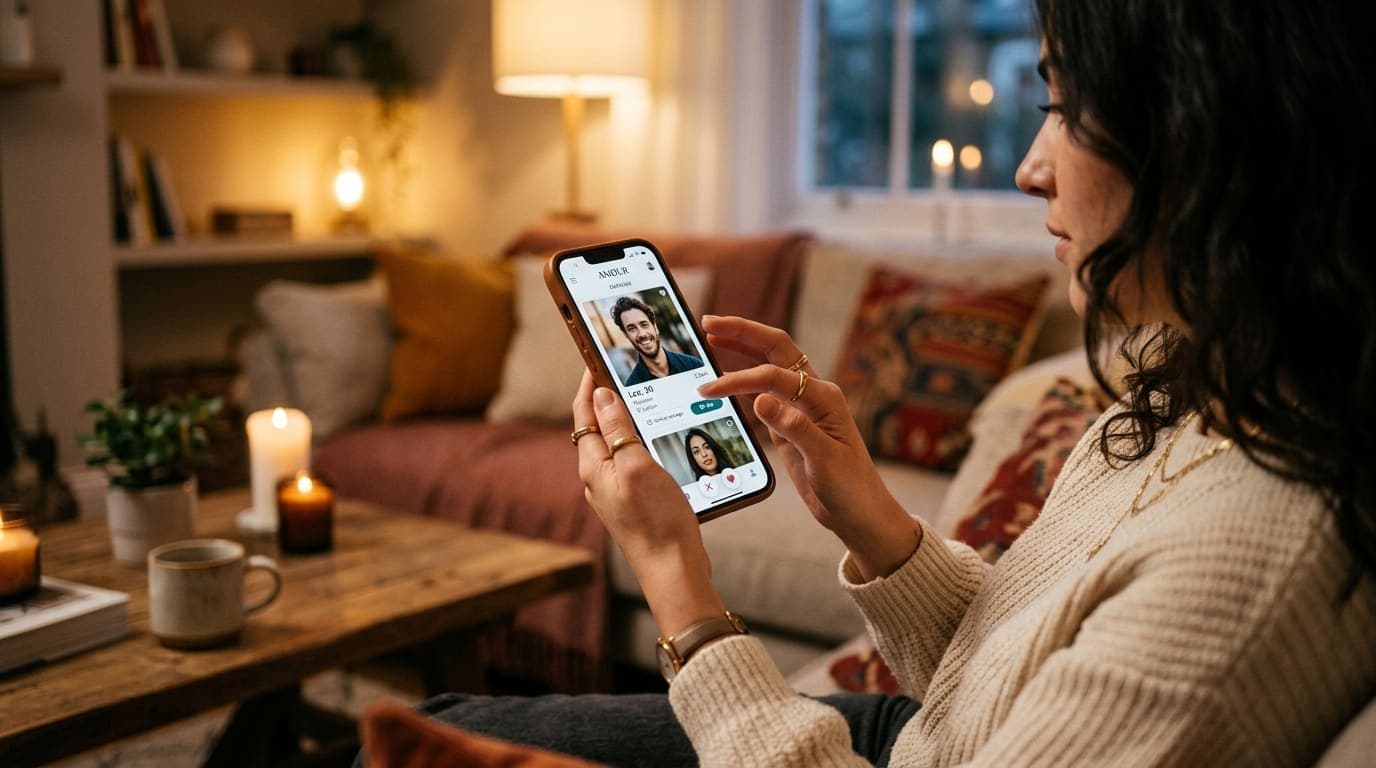
The old advice for checking a dating match was simple: ask for a selfie holding up today's newspaper, or run their photo through a reverse image search. Security researchers now describe both of those tests as effectively dead — AI tools can generate a photorealistic selfie of a person holding any object in any setting on demand, and a fully synthetic face has never appeared anywhere else online for a reverse search to find.
This isn't a fringe problem. The FTC reported over $1.16 billion in romance scam losses in just the first nine months of 2025 — up 22% from the same period the year before. Norton's 2026 research found that nearly half of current online daters in the US say they've been targeted by a dating scam, and of those targeted, 74% fell victim. Separate research found that people could correctly identify AI-generated faces only about half the time — essentially a coin flip, and in some tests, AI-generated faces were rated as more trustworthy-looking than real ones.
The tools scammers use have gotten better. The good news is that the signals worth checking have shifted too — here's what actually still works.
Why the old tests stopped working
Reverse image search used to catch a large share of fake profiles, because most scammers stole photos of real people from social media, and those photos could be found elsewhere online. That test still catches stolen-photo scams. It does nothing against a fully AI-generated face, because there's no original photo anywhere to find — the face was never real to begin with.
The custom-selfie request used to work because faking a specific, spontaneous photo on demand was hard. It no longer is. Modern image generators can produce a convincing photo of a nonexistent person in virtually any pose, setting, or context within seconds.
Both tests are still worth trying — they're free and catch the less sophisticated scams — but neither should be treated as sufficient on its own anymore.
What still works
- 1Request a live video call, and watch for specific behaviors. Real-time face-swapping technology exists, but it's harder to pull off convincingly than a still photo. Ask the person to do something a deepfake video struggles with in real time — turn their head fully to the side, pass a hand slowly across their face, or hold an object up close to the camera. Glitches, warping, or lighting inconsistencies around the face during these movements are a stronger signal than anything in a static photo.
- 2Look for the visual tells that still apply to still photos. Even sophisticated AI-generated faces often show some combination of: asymmetric or mismatched earrings/glasses, hair that blends unnaturally into the background, teeth or eyes that look slightly too uniform, or skin that's suspiciously smooth and evenly lit. These are the same categories of artifacts covered in how to tell if a photo is AI-generated — none are proof on their own, but multiple present at once is a real signal.
- 3Watch the profile pattern, not just the photo. Research into dating-scam networks has found recurring patterns in how fake profiles are built: a single standout feature (unusually striking eyes, smile, or style) meant to create fast attraction, and a disproportionate use of high-trust occupations — doctor, pilot, military, engineer — often paired with a built-in excuse to avoid meeting or video calling ("I'm deployed," "I'm on a rig"). A uniform or occupational prop in a profile photo, combined with reluctance to video call, is a well-documented combination worth treating as a flag.
- 4Watch the relationship pace, not just the photo. Security researchers consistently flag "love bombing" — intense affection, future-planning, and emotional intensity within the first days or weeks — as one of the most reliable behavioral signals of a scam, independent of whether the photos look real. Nearly 60% of romance scams tracked by the FTC in 2025 started on social media rather than dating apps specifically, so this applies well beyond dating platforms.
- 5Run suspicious photos through an AI detection tool as one additional check. An AI image detector analyzes pixel-level and generation artifacts that aren't always visible to the eye, which makes it a useful supplement to the visual checks above — especially for a photo that looks convincing at a glance but doesn't have anywhere else to be found online.
Like every method on this list, it's not infallible on its own — see can AI image detectors be fooled? — but combined with a reverse image search and a live video call, it meaningfully raises the bar a scammer has to clear.
One more thing worth knowing: voice cloning has gotten good enough to fake a convincing phone call too, not just a photo. If something about a call feels off — even from someone whose voice you recognize — an AI voice detector is worth running before you act on what you heard.
The one rule that still holds
Every fraud-prevention resource covering this problem converges on the same bottom line: never send money, gift cards, or financial information to someone you haven't met in person, regardless of how convincing their photos or conversation are. AI has made every earlier-stage test — photos, texts, even video calls — less reliable than it used to be. It hasn't changed what happens at the point actual money is requested, which remains the clearest and most reliable signal of all.
If you've already sent money or personal information to someone you now suspect is a scam profile, stop contact immediately, report it to the platform, and file a report with the FTC (reportfraud.ftc.gov) or FBI IC3 (ic3.gov).
Frequently asked questions
Can AI-generated faces really fool a reverse image search?
Yes, often completely — because the face doesn't correspond to a real person, there's usually no original photo to find anywhere else online.
Are all AI-generated dating profiles scams?
Not necessarily — some platforms and users experiment with AI-enhanced or generated images for privacy reasons. But an AI-generated photo combined with financial requests or urgency is a strong scam indicator and worth taking seriously.
Is it illegal to use an AI-generated photo on a dating profile?
This varies by platform policy and jurisdiction, and generally isn't itself illegal — but using one to deceive someone as part of a scam can cross into fraud.
Have a suspicious profile photo? Check it with our free AI image detector — no signup required.
Check it with our free AI image detector →