Can an AI-Generated Car Damage Photo Fool an Insurance Claims Review? We Put It to the Test
aimagedetector.ai Team · August 30, 2026 · 4 min read
A policyholder submits this photograph in support of a claim for front-end collision damage. Ordinary daylight, ordinary driveway, damage consistent with the account given.
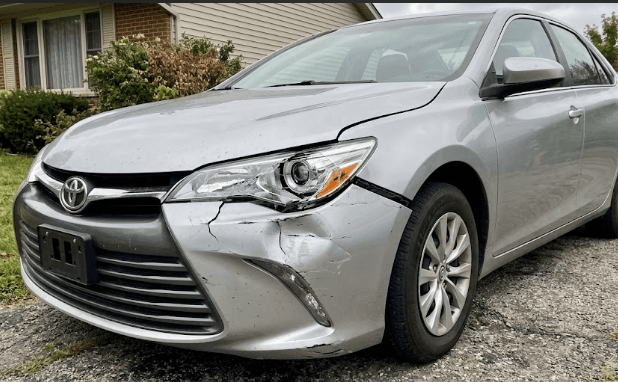
It never happened.
There is no car. There was no collision, no driveway, no claim. We generated the image in a few seconds, then submitted it to our own detector exactly the way a claims reviewer would process an upload — no special handling, no internal shortcuts.
We wanted to know how far a fabricated photograph gets before something stops it.
$300 billion
is what insurance fraud costs the U.S. industry every year, on figures from the National Insurance Crime Bureau and the Coalition Against Insurance Fraud.
1 in 10
property-casualty claims contain some element of fraud. Generative AI is making that worse, faster than most claims teams have adjusted to.
A 2026 Verisk survey found that the large majority of insurers now believe AI editing tools are fuelling a rise in digital insurance fraud, and nearly all report having already encountered manipulated or AI-generated material. CIFAS's 2025 annual review found that documents produced by current diffusion models fool human reviewers in the large majority of cases.
Making something worth catching
The image came from Google's Gemini model. The prompt was written deliberately to avoid an obvious “AI art” look — a photorealistic, slightly imperfect smartphone photo of a silver sedan with front-end damage, shot in a driveway under flat daylight.
Framed the way a policyholder frames a photograph, in other words, rather than the way a photographer does. That framing is the point: convincing fraud does not look impressive, it looks unremarkable.
The detector's reading
99
likely AI-generated, from multi-scale latent feature classification.
Nothing in the frame gave it away. The signature was in the texture underneath it.
The report, unedited
This is what came back. Not every line means what it looks like at first glance, so the four that matter are worth reading closely.
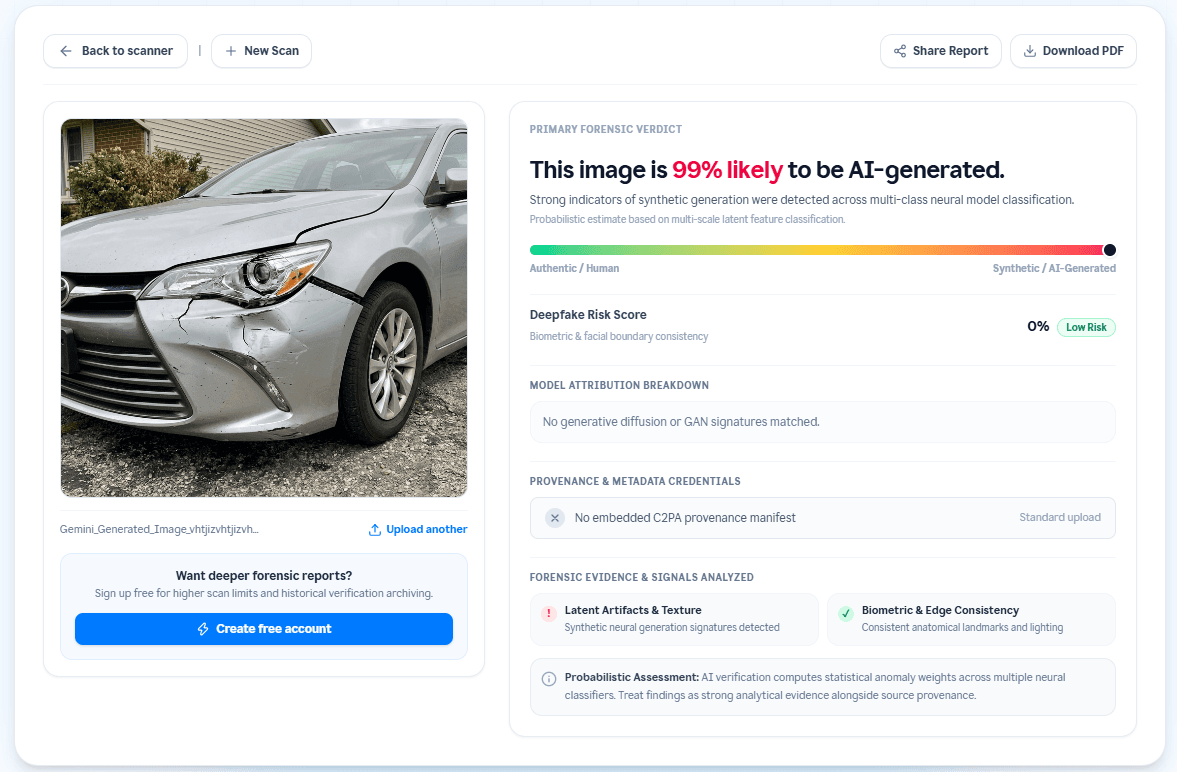
- Deepfake risk: 0%
- This score measures facial and biometric manipulation — face swaps, synthetic identity signs. It reads low because there is no face in the frame to evaluate. It is a separate check from the verdict above it, not a contradiction of it.
- Model attribution: no match
- No diffusion or GAN signature was confidently tied to a specific known generator, which happens with newer models. The verdict rests on generation artifacts broadly, not a single model fingerprint.
- Provenance: no C2PA manifest
- Expected for a standard upload — most real photographs also carry no content credentials. On its own this is the absence of a positive signal, not the presence of a negative one.
- Latent artifacts and texture: flagged
- The signal that actually drove the verdict. Synthetic neural generation signatures in the image's underlying texture — the pixel-level pattern that is invisible to the eye but consistent with how diffusion models build an image.
What this means if you review claims
A photograph that reads as completely convincing to a human reviewer — plausible damage, natural light, an ordinary setting — still carried a detectable synthetic signature underneath. That gap between looks real and is real is exactly where AI-assisted claims fraud is working today, and it is why photo review on its own is a weaker safeguard than it used to be.
This was one demonstration image, not an accuracy study, and no detector — including ours — catches every case or is immune to false positives. But it is a concrete look at the failure mode insurers are increasingly up against, and at what a multi-signal check surfaces that an eye cannot.
Run the same check on a photo of your own.
Methodology: the damage photograph in this study was created with Google's Gemini image model for demonstration purposes. It does not depict a real vehicle, real damage, or a real insurance claim.