What's Actually Inside Your Verification Report (A Walkthrough)
aimagedetector.ai Team · July 24, 2026 · 3 min read
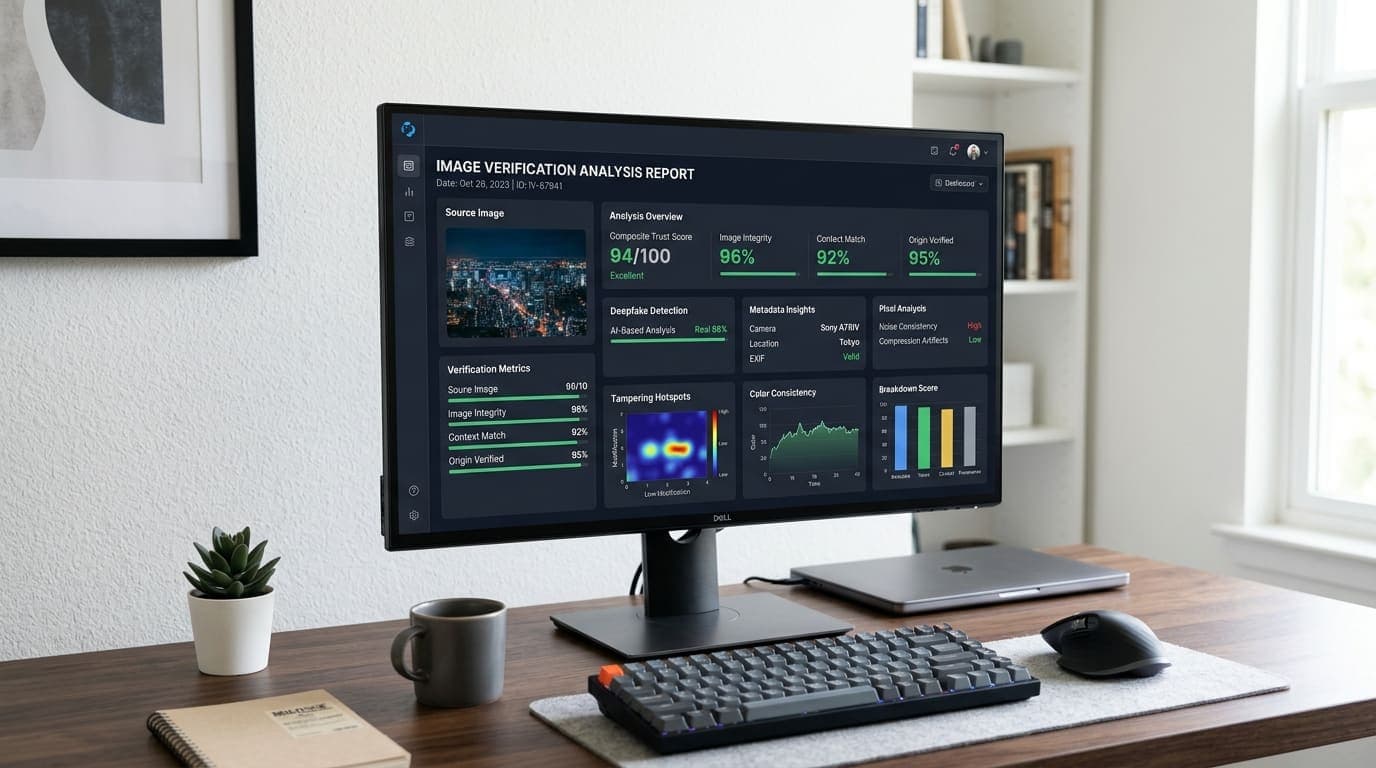
A lot of detection tools give you a single number and call it a day. We've always thought that's the least useful part of a verification result — a confidence score with no explanation isn't something you can act on, cite, or trust. Here's a walkthrough of what a full report is designed to include, and why each piece is there.
The verdict badge
At the top, you'll see a clear label — Likely AI-generated, Likely authentic, or Inconclusive — paired with a confidence percentage. This is meant to be the headline, not the whole story. Treat the percentage as a starting point for the "why," not a replacement for it.
The "why we think so" breakdown
This is the part that actually matters. Every flagged signal is listed individually, in plain language:
- 1Sensor fingerprint check. Whether the expected camera sensor noise pattern (PRNU) is present or absent.
- 2Frequency artifact scan. Whether repeating patterns consistent with generative upsampling show up in the image's frequency spectrum.
- 3Metadata review. Whether EXIF data is present, consistent, and plausible for the claimed source and device.
- 4Physical consistency checks. Shadow direction, reflection accuracy, and other physics-based signals that are hard for generators to get perfectly right.
Each of these is reported separately because they can — and often do — disagree with each other. A real photo that's been heavily compressed might lose its metadata and sensor fingerprint while still passing every physical consistency check. Seeing the individual signals, not just an aggregate score, is what lets you make a real judgment call instead of trusting a black box.
Why we show conflicting signals instead of hiding them
It would be easy to just average everything into one clean number and hide the messiness. We don't, because the messiness is often the most useful part. If three signals point one way and one points the other, that's meaningfully different from a case where every signal agrees — and it should look different in the report, not get smoothed over into the same single percentage.
Downloadable and shareable reports
On Pro and above, reports are designed to be exportable — something you can attach to an email, a case file, or a story draft. This exists because "trust me, I checked" isn't a great answer when someone asks how you know — having something concrete to point to is the actual point of verification in the first place.
What we're working on next
A few things already on the roadmap:
- 1Batch reporting for teams processing multiple images at once, with a summary view across a whole set.
- 2Video frame sampling, extending the same signal checks to key frames pulled from video content.
- 3Confidence calibration transparency — more detail on how the overall score is weighted from the individual signals, so the math isn't a mystery.
The philosophy behind it
A verification tool that just says "trust me" is asking you to replace one leap of faith with another. The goal of a real report is to give you enough to make your own call — and to be honest about the cases where the signals genuinely don't agree, instead of quietly picking a side for you.
Want to see a full report for yourself? Join the waitlist and we'll let you know the moment verification reports are live.
Get started free →